Glock 19 vs 17: Size, Capacity, Accuracy & Which to Choose
 Muhammad Bilal
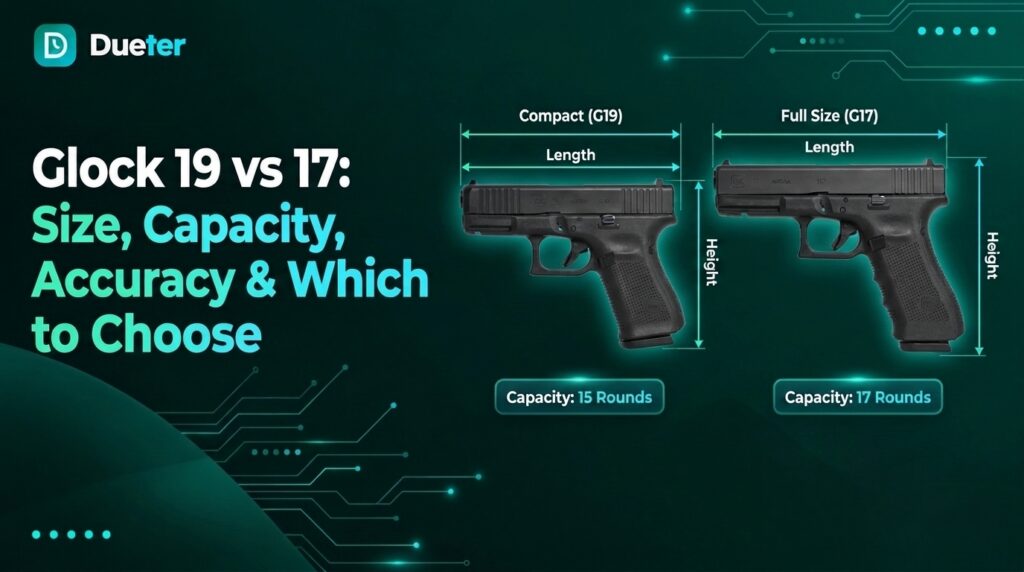
Walk into almost any American gun counter, and two black pistols usually sit near the front. The Glock 19 vs 17 debate has filled forums, range conversations, and buyer guides for decades. Both pistols fire the same 9mm cartridge, yet each one suits a different job.
Our look at iphone 16 pro vs pro max showed why comparisons need real numbers. This guide lays out the published dimensions, weights, and capacities of both pistols in inches and millimeters. It also explains history, accuracy, carry, home use, magazines, accessories, and common buyer mistakes.
Figures below come from published Gen5 specifications, which can vary slightly between generations and versions. Purchase and carry laws differ by state and country, so readers should check local rules first.
Quick Answer: What Is the Difference Between the Glock 19 and 17?
The Glock 17 is a full size 9mm with 17 rounds, while the 19 holds 15. The 17 carries a longer barrel and grip, while the compact 19 suits steadier daily carry. The 19 trims length and height for easier concealment with only two fewer rounds.
Glock 19 vs 17 at a Glance
A side by side table shows the headline differences before the detailed sections.
| Spec | Glock 19 Gen5 | Glock 17 Gen5 |
|---|---|---|
| Class | Compact | Full size |
| Caliber | 9mm Luger | 9mm Luger |
| Standard capacity | 15+1 | 17+1 |
| Overall length | 7.28 in (185 mm) | 7.95 in (202 mm) |
| Height | 5.04 in (128 mm) | 5.47 in (139 mm) |
| Width | 1.34 in (34 mm) | 1.34 in (34 mm) |
| Barrel length | 4.02 in (102 mm) | 4.49 in (114 mm) |
| Weight unloaded | About 23.8 oz (675 g) | About 25.1 oz (711 g) |
| Year introduced | 1988 | 1982 |
The pistols share the same width, so the real differences sit in length, height, and capacity.
The History of the Glock 17 and Glock 19
The Glock 17 started the company’s handgun story in the early 1980s in Austria. Gaston Glock designed it for an Austrian Army pistol trial, which the pistol won in 1982. Its polymer frame and simple controls looked unusual at the time but soon became an industry pattern.
The name 17 came from Glock’s seventeenth patent, not from the magazine capacity. The capacity match is a happy coincidence that still confuses many new buyers. American police departments began issuing the Glock 17 widely in the late 1980s.
Glock released the Glock 19 in 1988 as a shorter and smaller version of the same design. Police detectives, military units, and civilian carriers quickly embraced its smaller size. Over time, the 19 ranked among the best selling handguns in the United States.
| Year | Event |
|---|---|
| 1982 | Glock 17 wins the Austrian Army pistol trial |
| 1986 | Glock 17 reaches American buyers in large numbers |
| 1988 | Glock 19 launches as a compact model |
| 2017 | Gen5 versions arrive with updated barrels and grips |
The timeline shows how the 17 set the template and the 19 reshaped it for concealment.
Glock 19 vs 17: Size Comparison
Size drives most choices between these two popular 9mm pistols on the market. The sections below break each measurement down and explain what it means in daily handling.
Length
The Glock 19 measures 7.28 inches long, while the Glock 17 measures 7.95 inches long. That difference of about two thirds of an inch comes from the longer slide and barrel. Length matters most for holster depth and how deeply the muzzle sits inside a waistband.
Height
The Glock 19 stands 5.04 inches tall, and the Glock 17 stands 5.47 inches tall. The extra 0.43 inches on the 17 sits in the grip, which holds two more rounds. Taller grips print more under shirts but give larger hands more room to hold.
Width
Both pistols measure 1.34 inches across at the widest point of the frame. Identical width means many belt holsters and magazine pouches fit both models. Width also explains why both pistols feel similar in the hand from side to side.
Weight
Unloaded, the Glock 19 weighs about 23.8 ounces, and the Glock 17 weighs about 25.1 ounces. Fully loaded, the gap grows slightly because the 17 carries two extra rounds. Most shooters notice the extra weight more on the belt than in the hand.
Length difference: 7.95 in minus 7.28 in = 0.67 in (about 17 mm)
Height difference: 5.47 in minus 5.04 in = 0.43 in (about 11 mm)
Barrel difference: 4.49 in minus 4.02 in = 0.47 in (about 12 mm)
The simple math above shows that the two pistols differ by less than an inch in every direction.
Capacity and Magazine Compatibility
The Glock 17 ships with 17 round magazines, and the Glock 19 ships with 15 round magazines. Both pistols also accept longer factory magazines, such as 24 round and 33 round versions. Local laws in some states limit capacity, and Glock sells 10 round magazines for those markets.
A key advantage of the Glock 19 is that it accepts Glock 17 magazines. The longer magazine sticks out below the grip but feeds and locks normally. Many owners carry a 19 with a 17 magazine as a spare for extra rounds.
| Magazine | Fits Glock 19 | Fits Glock 17 |
|---|---|---|
| Glock 19 15 round | Yes | Not recommended |
| Glock 17 17 round | Yes, extends below grip | Yes |
| Glock 24 round extended | Yes | Yes |
| Glock 33 round extended | Yes | Yes |
The table shows that magazine sharing works best from the larger pistol to the smaller one.
Glock 19 vs 17: Which Is More Accurate?
Both pistols share the same trigger system and mechanical design, so their inherent accuracy stays close. The Glock 17 offers a longer sight radius, which is the distance between the front and rear sights. A longer sight radius makes small aiming errors easier to see and correct.
The Glock 17’s sight radius measures roughly 6.5 inches, while the 19 measures roughly 6 inches. Many shooters shoot slightly tighter groups with the 17 at longer distances. At typical self defense distances, the difference shrinks to almost nothing for skilled shooters.
The longer barrel on the 17 also gives bullets slightly more velocity in most loads. The gain stays modest and rarely changes real world performance with quality defensive ammunition.
Our review of iphone 17 vs 17 pro showed how small spec gaps matter less than daily fit. Pistol choices follow the same pattern, because comfort and practice outweigh fractions of an inch.
Recoil and Shooting Comfort
The Glock 17 usually feels slightly softer to shoot because of its extra weight and longer slide. More mass absorbs more recoil energy before it reaches the shooter’s hands. The longer grip also gives larger hands a fuller and more secure hold.
The Glock 19 still shoots comfortably for most adults because its grip fits three fingers. Recoil feels a little snappier, but the difference stays small for standard 9mm loads. Many instructors describe the 19 as the most balanced compact pistol for new shooters.
| Factor | Glock 19 | Glock 17 |
|---|---|---|
| Felt recoil | Slightly sharper | Slightly softer |
| Grip room | Three fingers for most hands | Full grip for large hands |
| Follow up shots | Fast | Slightly faster for many shooters |
| Long range sessions | Comfortable | Most comfortable |
The table shows that the 17 holds a small comfort edge, while the 19 trades little for portability.
Glock 19 vs 17 for Concealed Carry
The Glock 19 wins most concealed carry comparisons because of its shorter grip and slide. The shorter grip prints less under shirts, and the shorter slide sits more comfortably when sitting down. Many carriers wear the 19 all day inside the waistband without major discomfort.
The Glock 17 can still conceal well for taller people or those who wear looser clothing. Appendix carriers sometimes find the longer slide digs into the hip when they sit or bend. A quality holster and stiff belt make either pistol easier to carry for long periods.
| Carry style | Better fit | Reason |
|---|---|---|
| Inside waistband, daily wear | Glock 19 | Shorter grip prints less |
| Appendix carry | Glock 19 | Shorter slide sits more comfortably |
| Outside waistband, open carry | Glock 17 | Size matters less outside clothing |
| Winter carry under jackets | Either | Heavier clothing hides both well |
Most carriers who want one pistol for daily concealment choose the 19 after testing both.
Glock 19 vs 17 for Home Defense
For home use, size and concealment matter less than control and capacity. The Glock 17 offers two extra rounds and a longer sight radius for steadier aiming. Its full size grip also helps under stress, when fine motor control suffers.
The Glock 19 still serves well at home, especially for owners who also carry it daily. Training with one pistol for both roles builds consistent skill and muscle memory. Owners who keep separate pistols for carry and home often pick the 17 for the bedside safe.
Do not store any pistol where children or unauthorized visitors can reach it. A quick access safe or lock box keeps the pistol available while preventing tragic accidents.
Glock 19 vs 17 for Duty and Competition
Police departments around the world issue both models, depending on officer roles and preferences. Uniformed officers often carry the 17 in duty holsters, while detectives often carry the 19. Several federal agencies in the United States also issue Glock 9mm pistols to agents.
In competition, the Glock 17 usually holds an edge because of its sight radius and weight. Shooters in practical shooting divisions often pick full size pistols for faster and steadier splits. The Glock 19 still competes well in local matches where carry gear and practicality matter.
Crossover Options: Glock 19X and Glock 45
Glock also sells crossover models that mix features from the 17 and 19. The Glock 19X pairs a full size frame with a compact length slide and barrel. The Glock 45 follows the same idea in black, with front slide serrations and a slightly different look.
These crossover pistols suit buyers who want the 17 grip with the shorter 19 slide. They hold 17 rounds in standard magazines and fit many holsters made for the 19 slide. Buyers who cannot choose between the two classic models often test a crossover first.
| Model | Frame size | Slide length | Standard capacity |
|---|---|---|---|
| Glock 19 | Compact | Compact | 15+1 |
| Glock 17 | Full size | Full size | 17+1 |
| Glock 19X | Full size | Compact | 17+1 |
| Glock 45 | Full size | Compact | 17+1 |
The table shows how crossovers sit between the two classic models in size and capacity.
Generation Differences: Gen3, Gen4, and Gen5
Both models have gone through several generations, and each one changed details buyers notice. Gen3 pistols added finger grooves and an accessory rail to the frame. Many used pistols on the market still come from this popular generation.
Gen4 pistols introduced interchangeable backstraps, a rougher grip texture, and a dual recoil spring. The magazine catch also grew larger and became reversible for left handed shooters. These changes made grip size easier to adjust for different hand shapes and sizes.
Gen5 pistols removed the finger grooves, added an ambidextrous slide stop, and flared the magazine well. Glock also introduced a new barrel with different rifling, which it calls the Marksman barrel. Most new Glock 19 and 17 pistols sold today come from this generation.
| Generation | Key changes |
|---|---|
| Gen3 | Finger grooves and accessory rail |
| Gen4 | Backstraps, dual recoil spring, larger magazine catch |
| Gen5 | No finger grooves, ambidextrous slide stop, flared magwell |
Holsters and some parts differ between generations, so buyers should confirm the exact version.
Fit by Hand Size
Hand size shapes comfort more than most buyers expect before they hold both pistols. The table below shows common patterns that instructors often notice in beginner classes.
| Hand size | Glock 19 feel | Glock 17 feel |
|---|---|---|
| Small | Comfortable, easy reach | Grip may feel long |
| Medium | Full three finger grip | Full grip with extra room |
| Large | Pinky may sit near the base | Most natural and complete grip |
Smaller hands often prefer the 19, while larger hands often settle on the 17 after testing.
Backstraps on Gen4 and Gen5 pistols can change grip depth slightly for a better fit. Grip tape, sleeves, and magazine base plates also help shooters fine tune the feel.
Reliability and Maintenance
Both pistols share Glock’s reputation for simple design and dependable function in harsh conditions. They use few parts, and owners can field strip either one without tools in about a minute. Basic cleaning covers the barrel, slide rails, and recoil spring assembly after range sessions.
Police agencies and armies have tested both models across decades of daily use. This long track record means parts, armorers, and repair guides exist almost everywhere. A local Glock armorer can inspect either pistol and replace worn springs during routine service.
Price and Value
The Glock 19 and 17 usually sell at nearly identical prices in most American gun stores. MOS optic ready versions cost more than standard versions of either pistol. Prices change by region, season, and retailer, so buyers should compare several local stores.
Value also depends on the gear each pistol needs, such as holsters, magazines, and sights. Because magazines and accessories overlap heavily, owning both pistols costs less than many buyers expect. Used Gen3 and Gen4 pistols also offer good value for buyers on tight budgets.
Benefits of the Glock 19
The compact Glock 19 brings several clear strengths for everyday owners and carriers:
- Its shorter grip and slide conceal well under most daily clothing styles.
- It accepts Glock 17 magazines, which adds flexible capacity for home or range use.
- Its size suits carry, home defense, and training, so one pistol covers many roles.
- A huge market of holsters, sights, and parts supports the pistol in most countries.
Benefits of the Glock 17
The full size Glock 17 offers its own advantages for certain shooters:
- Two extra rounds in standard magazines give more capacity without extended magazines.
- The longer sight radius helps many shooters aim more precisely at longer distances.
- Extra weight and a longer grip soften felt recoil during long practice sessions.
- Its full size frame suits duty holsters, competition gear, and larger hands well.
Who Should Choose the Glock 19?
The Glock 19 suits buyers who want one pistol for nearly every purpose. People who carry daily under ordinary clothing usually find it easier to live with than the 17. Its balance of size and capacity explains why many instructors call it a default choice.
Owners with small or medium hands also tend to prefer the 19 after a range test. Its grip lets most adults reach the trigger and controls without shifting their hold.
Who Should Choose the Glock 17?
The Glock 17 suits buyers who mainly want a pistol for home defense, training, or competition. Shooters with larger hands often find its grip more natural and comfortable. Uniformed officers and open carriers also benefit from its full size control.
Taller carriers who wear looser clothing can still conceal the 17 with a good holster. Owners who value accuracy at longer distances often appreciate its longer sight radius.
Holsters, Sights, and Accessories
Holsters for the two pistols usually differ because slide length changes the holster shape. Some open bottom holsters fit both pistols, since the extra slide length can pass through. Buyers should always check the holster maker’s fit list for the exact model and generation.
Both pistols use the same sight dovetails, so night sights and fiber optic sights swap easily. Both models also come in MOS versions with optic ready slides for red dot sights. Accessory rails on both frames accept the same compact weapon lights and lasers.
Magazine pouches often fit both pistols because the magazines share the same width. This overlap helps owners who keep both models build one simple set of gear.
Real World Example: Picking Between the Two
Consider a fictional buyer named Bilal who wants one 9mm for carry, home defense, and training. He works in an office and wears untucked button shirts most days. He also plans to take a beginner course and shoot twice a month.
At the range, he rents both pistols and fires one hundred rounds through each one. The Glock 17 shoots slightly tighter groups, but the 19 feels nearly as steady. At home, he tests concealment with an unloaded pistol and finds the 17 grip prints badly.
Bilal chooses the Glock 19 and buys two spare Glock 17 magazines for home use. The example is invented, but many buyers settle the debate through the same practical tests.
How to Choose Between the Glock 19 and 17
A short process helps buyers pick the right pistol for their needs.
Step 1: Confirm Local Laws
Check purchase rules, carry permits, and magazine capacity limits in the buyer’s state or country. Legal requirements shape every other choice, so this step always comes first.
Step 2: Define the Main Use
Decide whether carry, home defense, competition, or general practice matters most right now. A clear main use points toward the compact 19 or the full size 17.
Step 3: Test Grip and Fit
Hold both pistols in a store and note how the grip fills the hand. Larger hands often prefer the 17, while medium hands often feel fine on the 19.
Step 4: Shoot Both Models
Rent both pistols at a range and compare comfort, speed, and group size. Real shooting reveals comfort and control differences that spec sheets cannot show.
Step 5: Test Concealment at Home
Wear daily clothing with an unloaded pistol and a quality holster for an afternoon. Printing and comfort during sitting and driving often decide the final choice.
Step 6: Budget for Gear and Training
Set aside money for holsters, belts, spare magazines, practice ammunition, and professional instruction. Training improves safety and skill more than any difference between these two pistols.
Common Mistakes in the Glock 19 vs 17 Choice
Buyers often repeat a handful of errors when they compare these two pistols.
1. Assuming the Model Number Equals Capacity
The 17 name came from a patent count, and the 19 holds 15 rounds. Buyers should read magazine capacity directly from the box or spec sheet.
2. Choosing the 17 for Deep Concealment Without Testing
Full size grips print more under fitted clothing than many buyers expect. Testing concealment at home prevents a purchase that ends up in a drawer.
3. Buying Holsters Before Choosing the Model
Slide length changes holster fit between the two pistols and between generations. Buyers should pick the exact pistol first and then order matching gear.
4. Ignoring Magazine Compatibility
Some owners buy the wrong spare magazines because they assume sharing works both ways. The 19 accepts 17 magazines, but the reverse does not work well.
5. Skipping Professional Training
A new pistol needs safe handling skills, storage habits, and regular practice. Professional courses teach these basics faster and safer than self study alone.
Tips for Owning a Glock 19 or 17
Owners can stay safer and more confident with six simple daily habits:
- Use a holster that fully covers the trigger guard every time the pistol is carried.
- Store the pistol in a locked safe whenever it is not carried or under direct control.
- Practice dry fire with an unloaded pistol and no ammunition anywhere in the room.
- Clean and lubricate the slide rails and barrel after each range session.
- Replace recoil springs according to Glock’s service guidance after heavy range use.
- Test every carry magazine and defensive load at the range before trusting it.
Glock 19 vs 17 Buyer Checklist
Buyers can use this short checklist before making any final purchase decision:
- Confirm purchase, carry, and magazine capacity laws in the buyer’s state or country.
- Decide whether daily carry, home defense, or competition is the main purpose.
- Hold both pistols in a store and judge grip fit with the shooting hand.
- Rent both models and compare comfort, speed, and accuracy at the range.
- Check holster fit lists for the exact model, generation, and optic or rail version.
- Budget for a safe, professional training, spare magazines, and plenty of practice ammunition.
Glock 19 vs 17 by Body Type and Clothing
Body shape changes how each pistol carries, so the same choice does not suit everyone. Taller people with longer torsos often hide the Glock 17 grip more easily. Shorter people usually find that the 17 grip presses into the ribs or prints under shirts.
Clothing matters as much as height when carriers compare the two pistols. Fitted shirts and light summer fabrics favor the shorter Glock 19 grip. Untucked flannels, hoodies, and jackets hide either pistol well for most people.
Seated work deserves special attention, because sitting pushes the muzzle and grip into new positions. Drivers and office workers often prefer the 19 because its shorter slide digs in less. Testing a full workday with an unloaded pistol and holster reveals these issues before purchase.
Questions to Ask at the Gun Store
A few simple questions help buyers get useful answers from store staff. Buyers can ask which generation and version the store stocks, including MOS optic ready models. They can also ask whether the store runs a rental range for testing both pistols.
Another useful question covers which holsters and belts the staff have tested with each model. Staff who carry these pistols often know which holsters print least for different body types. Buyers should also ask about local beginner classes that cover safe handling and storage.
Finally, buyers should ask about warranty service, return policies, and armorer support nearby. A store that explains these details clearly usually supports customers well after the sale.
Frequently Asked Questions
What is the main difference between the Glock 19 and 17?
The main Glock 19 vs 17 difference is size, since the 17 is full size. The 17 holds 17 rounds, while the compact 19 holds 15 rounds.
Is the Glock 19 smaller than the Glock 17?
Yes, the Glock 19 is shorter and lower than the Glock 17. It measures 7.28 inches long and 5.04 inches tall, while the 17 measures 7.95 by 5.47 inches.
Can a Glock 19 use Glock 17 magazines?
Yes, a Glock 19 accepts Glock 17 magazines, which extend below the shorter grip. This feature makes Glock 17 magazines popular spares for Glock 19 owners.
Which is more accurate, the Glock 17 or 19?
The Glock 17 offers a longer sight radius, which helps many shooters aim more precisely. In the Glock 19 vs 17 comparison, accuracy differences stay small at typical defensive distances.
Which is better for concealed carry?
The Glock 19 usually works better for concealed carry because its grip and slide are shorter. The Glock 17 can still conceal under looser clothing for taller carriers.
Which is better for home defense?
Many owners prefer the Glock 17 for home defense because of its capacity and steadier grip. The Glock 19 still works well, especially for owners who carry it daily.
Do the Glock 19 and 17 have the same width?
Yes, both pistols measure about 1.34 inches wide in published Gen5 specifications. Their shared width lets many magazine pouches and some holsters fit both models.
Why is the Glock 17 called the 17?
The Glock 17 name comes from Glock’s seventeenth patent, not its magazine capacity. The 17 round capacity is a coincidence that many buyers find confusing.
What is a Glock 19X?
The Glock 19X combines a full size grip with a compact length slide and barrel. It holds 17 rounds and sits between the classic 19 and 17 models.
Which Glock should a beginner buy?
Many instructors suggest the Glock 19 for beginners who want one pistol for carry and practice. Beginners should still test both pistols in the Glock 19 vs 17 debate before buying.
Key Takeaways
- The Glock 17 is a full size 9mm, while the Glock 19 is a compact version.
- The Glock 17 holds 17 rounds, and the Glock 19 holds 15 rounds in standard magazines.
- Both pistols measure about 1.34 inches wide, so the main differences are length and height.
- The Glock 17 barrel measures 4.49 inches, while the Glock 19 barrel measures 4.02 inches.
- The Glock 19 accepts Glock 17 magazines, but sharing works poorly the other way.
- A longer sight radius gives the Glock 17 a small accuracy edge at longer distances.
- The Glock 19 usually conceals better because of its shorter grip and slide.
- Many owners prefer the Glock 17 for home defense and competition shooting.
- The Glock 19X and Glock 45 combine a full size grip with a compact slide.
- Both models share sights, accessory rails, and optic ready versions for red dots.
- Local laws, hand size, and main use should guide the final choice between them.
- Professional training and safe storage matter more than any small spec difference.
Final Thoughts
The Glock 19 vs 17 choice comes down to concealment versus full size control. The 19 suits daily carry and all round use, while the 17 suits home defense, duty, and competition. Testing both at a range and checking local laws first leads most buyers to a confident choice.
Explore more product comparison guides on Dueter.